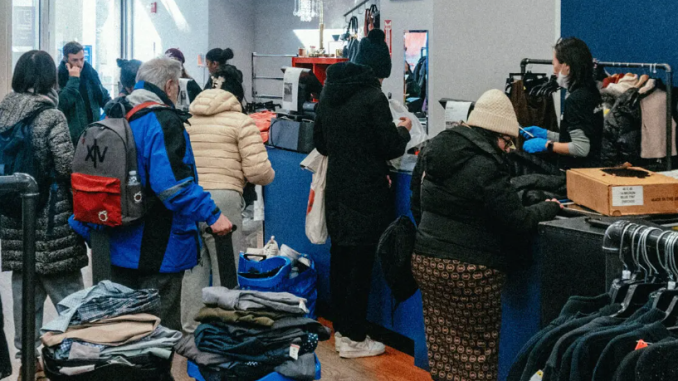
That is good news for the nonprofit organization that oversees Goodwill, the world’s largest thrift store chain. But it also signals that Americans in an uncertain economy are trying to stretch their dollars as far as possible.
The organization, Goodwill Industries, said it surpassed $7 billion in revenue — a record — from its 3,400 stores in 2025, up roughly 7 percent from the previous year.
[snip]
Across the consumer economy, holiday spending remained strong last year, and consumers are still spending on discretionary goods, even if they have to defer the costs through “buy now, pay later” plans. But a cocktail of inflation, slowing job growth and lofty bills for groceries and rent has left American households looking to eke out as much as they can with every purchase.
On a cold January day, David Collon, 48, went to a Goodwill store in northern Manhattan looking for sweatpants and sweaters. “They have a good selection, and I’m looking for a very good price at this time,” said Mr. Collon, who works as a groundskeeper. “It’s hard times. This brings down the pain of spending for clothes.”
Goodwill shops present a sensory overload of inventory. Shoppers go for the low prices, but also the treasure hunt of rifling through aisles of shirts and dresses for hidden gems. At the outlets that sell items lumped together in bins, some customers wait for hours for goods to be refreshed to maximize their hauls.
[snip]
Thrift stores are some of the only places that can offer $5 T-shirts and $15 jeans, and are shielded from tariff-related price increases because they don’t import goods manufactured abroad.
“Secondhand stores are benefiting from many of the same forces we’re seeing across the broader economy,” said Michelle Meyer, chief economist of the Mastercard Economics Institute. “Consumers are becoming far more value‑conscious.”
Goodwill is a nonprofit business that relies on donations and its retail stores to fund its programs, which include career skills training, education and community programs for those in need. It also offers services for formerly incarcerated people to re-enter the work force.
[snip]
Executives are trying out partnerships with retailers to prompt more donations. Last year, Goodwill began a pilot project with Amazon, hosting return kiosks inside its stores so that customers can combine their drop-off errands.
In addition to the slowing economy, shifting consumer trends are boosting Goodwill’s sales. Much of the growth is coming from Generation Z and millennials who see secondhand clothes not only as cheaper but also as more sustainable and fashionable.
Goodwill’s annual sales are up nearly 50 percent from 2019, in part because of young shoppers like Steph Tauszik, 20, a student at the Fashion Institute of Technology in Manhattan, who was shopping for a winter coat at a Goodwill store. “It’s cheaper, and it’s good for the planet in terms of not over consuming,” she said.
“It’s an entire shift in mind-set,” said David Eagles, Goodwill’s chief operating officer. “It’s sustainable, it’s personal, it’s local.”
Image

These days, young consumers are sharing their thrift hauls on TikTok and YouTube, showing off the clothes they often find from online resellers like the RealReal, Depop and Poshmark.
[snip]
Management sees the secondhand surge as an opportunity for expansion. That means more places for Goodwill to both gather goods and sell them.
This year, Goodwill expects to add between 50 and 100 new stores across North America.
“I’m hopeful we will accelerate growth,” Mr. Eagles said, adding that 2026 “will probably be our biggest year yet — that’s our goal.”
* Original Article:
https://www.nytimes.com/2026/01/26/business/goodwill-sales-economy.html?unlocked_article_code=1.HVA.XELi.sdgm9ww608ic&smid=url-share